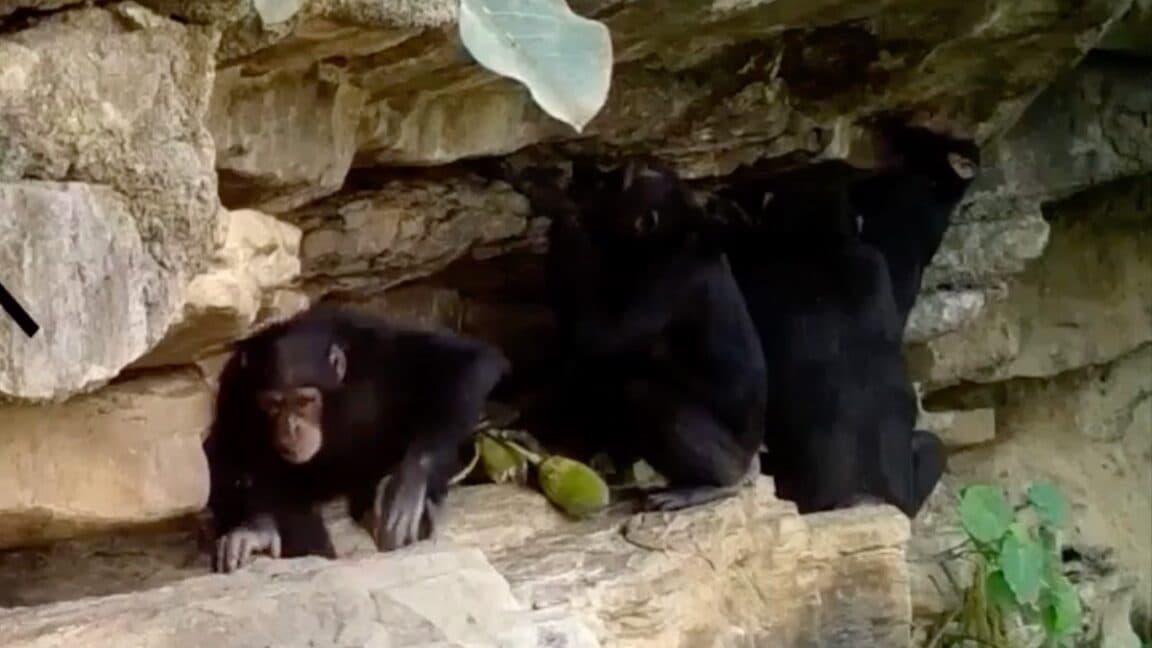
How chimps teach their kids tool tricks
Chimpanzees are known to use rudimentary tools when foraging for food. Based on to a new paper in the journal Frontiers in Psychology, this learned behavior is passed down from adults to offspring through social learning. Specifically, adult chimps deliberately model the behavior, then turn their...
Chimpanzees are known to use rudimentary tools when foraging for food. Based on to a new paper in the journal Frontiers in Psychology, this learned behavior is passed down from adults to offspring through social learning. Specifically, adult chimps deliberately model the behavior, then turn their tools over to the youngsters so they can mimic the same motions.
“Receiving food and tools from experienced individuals, which we call food or tool transfer, may help chimpanzees learn to use technology to extract foods that are difficult to access,” stated co-author Andreu Sánchez-Megías, a graduate student at the University of Barcelona and the Jane Goodall Institute Spain in Senegal. “Tool transfers thus appear to be a form of teaching, together with observation and supervised practice. It appears that mothers are the main models and teachers for young chimpanzees in this manner.”
As we have previously indicated, tool use was once thought to be one of the defining features of humans, although Charles Darwin observed chimpanzees using stones to crack nuts in 1871. In 1960, the late primatologist Jane Goodall observed a chimp named David Greybeard bend a twig, strip off the leaves, and use it to spoon termites out of a nest and into his mouth. When he learned of the behavior, Goodall’s mentor, Louis Leakey, famously observed, “Now we must redefine ‘tool,’ redefine ‘man,’ or accept chimpanzees as humans.” Since then, chimps have been observed making sponges out of leaves to soak up liquids, shaping sticks to collect algae, and sharpening rudimentary spears for hunting.
Other examples of tool use have been observed in various species, although the behavior seems to have evolved more frequently among monkeys and apes. Dolphins can toss objects as a form of play, which some scientists consider to be a type of tool use, particularly when it involves another member of the same species. Potential purposes include communication, social bonding, or aggression. (Octopuses have also been observed engaging in similar throwing behavior.)
Related Articles
 AI
AIEmTech Future 2026: When AI Meets Everything
Only available to MIT Technology Review subscribers. Yossi Matias, Vice President & Head of Google Research, explores how AI is beginning to reshape biology, infrastructure, manufacturing, and science, and why its greatest impact may come when it intersects with other fields. Step inside the ne...
 AI
AITrump names U.S. intelligence chief Jay Clayton as new AI czar
U.S. President Donald Trump stated on Sunday he had named Jay Clayton, the director of national intelligence, as the administration's artificial intelligence czar, tasking him with co-ordinating the administration's efforts to maintain U.S. leadership in the technology. Trump, who has pushed to...